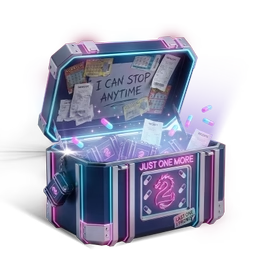
Counter-Strike 2 (CS2) has inherited not just the legacy of its predecessor, CS:GO, but also a massive, multi-million-dollar secondary economy. At the center of this economy are weapon skins—virtual cosmetics that hold real-world monetary value. As the value of these digital items has grown, so too has the phenomenon of the CS2 casino.
For players looking to understand how this ecosystem operates, navigating the world of CS2 gambling requires a careful look at the mechanics, the types of platforms available, and the inherent risks involved.
What is a CS2 Casino?
A CS2 casino is an online gambling platform that allows users to wager virtual items (skins) or cryptocurrency on various games of chance. Unlike traditional online casinos that deal exclusively in fiat currency or crypto, CS2 gambling sites are uniquely intertwined with Valve’s Steam ecosystem, utilizing peer-to-peer (P2P) trading systems and API integrations to facilitate deposits and withdrawals.
The core of this ecosystem is the CS2 skin. Because rare knives and gloves can command prices ranging from a few hundred to tens of thousands of dollars, skins effectively function as a specialized digital currency.
Popular Games Found on CS2 Gambling Sites
CS2 casinos typically offer a mix of traditional casino games tailored to the gaming community, alongside proprietary games built specifically around skin trading.
Common Game Modes
- Crash: A multiplier starts at 1.0x and climbs upward. Players must cash out before the multiplier randomly “crashes.” If they fail to cash out in time, they lose their wager.
- Roulette: Similar to traditional roulette, players bet on colors (often red, black, and green) where the winning outcome is determined by a provably fair algorithm.
- Case Opening: Simulating Valve’s in-game case openings, but often with significantly better (or custom-adjusted) odds and special tiered reward systems.
- Coinflip: A direct player-versus-player (PvP) game where two users wager items of roughly equal value, and a virtual coin flip determines the winner of the entire pot.
- Jackpot: Multiple players throw skins into a common pot. The more a player contributes relative to the total value, the higher their percentage chance of winning the entire pool.
Overview of CS2 Casino Features
To attract users, modern CS2 casinos offer a variety of features designed to streamline the user experience and incentivize continuous play.
| Feature | Description | Common Purpose |
|---|---|---|
| P2P Trading | Direct trades between players managed by the site’s bot network. | Faster deposits and withdrawals without standard Steam trade holds. |
| Provably Fair | Cryptographic systems allowing users to verify game outcomes. | Ensuring the casino isn’t manipulating spin results or crash points. |
| Sign-up Bonuses | Free balance, deposit matches, or free cases for new users. | Customer acquisition and platform retention. |
| Crypto Integration | Support for Bitcoin, Ethereum, GBPT, and Litecoin alongside skins. | Providing liquidity and alternative banking methods for users. |
| Live Chat & Rains | Community chat features where small amounts of crypto/skins are periodically dropped. | Fostering community engagement and keeping players active on the site. |
The Economics and Valve’s Stance
Valve, the developer of Counter-Strike 2, has historically taken a strict stance against third-party gambling sites. Over the years, Valve has implemented numerous updates to curb skin gambling, including:
- 7-Day Trade Holds: When a skin is traded, it cannot be traded again for seven days, significantly slowing down automated gambling bots.
- API Key Restrictions: Cracking down on automated trading bots that masquerade as legitimate user accounts.
- Mass Ban Waves: Periodically targeting and banning thousands of bot accounts associated with major gambling networks.
Despite these measures, the CS2 casino industry continues to adapt, shifting toward peer-to-peer architectures and cryptocurrency integration to bypass direct Steam inventory interactions when necessary.
Risks Associated with CS2 Gambling
While CS2 casinos can be entertaining for some, they carry significant financial, technical, and legal risks that participants must consider.
Key Risks to Keep in Mind:
- Lack of Regulation: Most CS2 casinos operate out of offshore jurisdictions with minimal regulatory oversight, meaning players have little recourse if a site refuses to pay out winnings.
- Financial Loss: Like all forms of gambling, the house always has an edge. The volatility of skin prices can also lead to unexpected losses even if a player breaks even on bets.
- Account Security: Logging into third-party sites via Steam OpenID or trading high-value items puts users at risk of phishing scams, API scams, and potential theft of their entire inventory.
- Underage Gambling: Because these sites use video game items as currency, they often attract younger demographics who may not fully understand the financial consequences of gambling.
Frequently Asked Questions (FAQ)
1. Are CS2 casinos legal?
The legality depends entirely on your jurisdiction. In some countries and U.S. states, online gambling is strictly regulated or outright banned. Furthermore, using third-party gambling sites violates the Steam Subscriber Agreement, which can lead to your Steam account being restricted or banned.
2. What does “Provably Fair” mean?
“Provably fair” is a cryptographic system used by online casinos to allow players to verify that the outcome of each bet was fair and unmanipulated. It uses a combination of server seeds, client seeds, and hashes generated before the bet is placed.
3. Can I withdraw real money from CS2 casinos?
Most CS2 casinos do not let you directly cash out to a bank account. Instead, players typically withdraw skins, sell them on third-party marketplace websites for real cash, or withdraw via cryptocurrencies that can then be exchanged for fiat currency.
4. Why do CS2 gambling sites use skins instead of cash?
Using skins allows these platforms to operate in a legal gray area in certain regions, as virtual items are technically considered the intellectual property of Valve. It also appeals directly to the gaming community’s desire to upgrade or trade their in-game cosmetics.
The CS2 casino landscape is a complex and rapidly evolving extension of the Counter-Strike ecosystem. While the allure of turning a cheap weapon skin into a high-tier knife drives millions of visits to these platforms, the underlying risks—ranging from financial loss to account bans—are substantial. For anyone engaging with this space, maintaining strict personal limits, understanding the mechanics of provably fair gaming, and recognizing the policies of the Steam platform are essential steps.
Learn how a CSGO Gambling works, from skins-based games and offers to account security, fair play, and responsible betting. Visit csgamblingsite.com now.