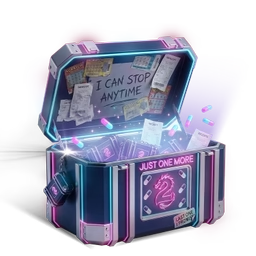
The phenomenon of case opening has transcended traditional video game economies to become a massive subculture of its own. Whether players are unlocking weapon skins in tactical shooters, trading digital cards, or collecting rare cosmetics, the thrill of the virtual unboxing is a universal experience.
For the uninitiated, case opening can seem confusing, if not entirely intimidating. However, understanding the mechanics behind these systems reveals a fascinating intersection of probability, economics, and human psychology. This guide explores the mechanics of case opening, the psychological triggers behind its popularity, and strategic approaches for enthusiasts.
What is Case Opening?
At its core, case opening is a mechanic where a player uses virtual currency, real-world money, or earned tokens to unlock a randomized container (often referred to as a case, crate, box, or loot box). Upon opening, the container grants the player a digital item.
These items generally fall into different tiers of rarity, ranging from common, everyday drops to ultra-rare, highly coveted collector’s items that can hold significant real-world value on secondary marketplaces.
Common Rarity Tiers in Case Openings
| Rarity Tier | Approximate Drop Rate | Market Value | Description |
|---|---|---|---|
| Common / Consumer | 75% – 80% | Very Low | Basic items that drop frequently; often used for crafting or trade-ups. |
| Uncommon / Industrial | 15% – 20% | Low | Slightly more distinct than common items, but still widely accessible. |
| Rare / Mil-Spec | 3% – 5% | Low to Moderate | Noticeably better aesthetics; the baseline for most satisfying pulls. |
| Classified / Restricted | 0.8% – 1% | Moderate to High | Highly stylized items that stand out in-game. |
| Covert / Legendary | 0.2% – 0.4% | High to Very High | Premium items with intricate designs and animations. |
| Exotic / Special | < 0.1% | Extremely High | The rarest tier (e.g., knives, gloves, ultra-rare drops). Highly sought after. |
The Mechanics: How Do Cases Work?
Behind the flashy animations and flashing lights of a case opening interface lies complex mathematics. Understanding these mechanics helps demystify the process.
1. Pseudorandom Number Generation (PRNG)
When a player clicks “open,” the game’s server uses an algorithm called a Pseudorandom Number Generation (PRNG) system to determine the outcome instantly. Despite the spinning wheel or scrolling items on the screen creating suspense, the item is chosen the exact millisecond the request is processed. The visual animation is merely for entertainment.
2. House Edge and Odds Transparency
Most regulated gaming ecosystems are required to disclose the exact odds of pulling items from a case. Much like a casino, the “house” always wins in the long run. The statistical expected value (EV) of the items inside a case is almost always lower than the cost required to purchase the key and the case itself.
The Psychology Behind the Thrill
Why do millions of players partake in case openings despite the mathematical odds being stacked against them? The answer lies in behavioral psychology.
- Variable Ratio Reinforcement: This is the exact psychological mechanism that makes slot machines addictive. Because rewards are unpredictable—sometimes you win big, but usually you don’t—the brain releases a surge of dopamine in anticipation of the reward.
- The “Near Miss” Effect: Many case-opening animations feature the scrolling item stopping just one pixel away from a rare, ultra-valuable item. This triggers a cognitive bias that tricks the brain into thinking, “I was so close! I’ll get it next time.”
- Social Proof and Streamer Culture: Watching content creators open thousands of dollars worth of cases creates a distorted perception of reality. Viewers see the massive wins (the 0.1% drops) while ignoring the hundreds of uninteresting, low-tier items opened off-camera.
Strategies for Smart Case Opening
While case opening is primarily a game of chance, enthusiasts can adopt certain strategies to manage their budgets and maximize their enjoyment.
- Set a Strict Budget: Never spend money on cases that you cannot afford to lose. Treat case opening strictly as entertainment expense, akin to going to a movie or buying a lottery ticket.
- Direct Purchase vs. Gambling: If you have your eye on a specific item, buying it directly from a community marketplace is almost always cheaper than trying to unbox it yourself through randomized cases.
- Understand the Trade-Up Economy: Many games allow players to trade up ten lower-tier items for one item of the next higher tier. Collecting common drops for trade-ups can be a more controlled way to chase better items.
- Avoid the “Chasing Losses” Trap: If you experience a bad streak of openings, accept the loss and step away. Doubling down to win back spent money usually leads to severe financial regret.
Frequently Asked Questions (FAQ)
1. Is case opening considered gambling?
The legal classification of case opening varies by jurisdiction. Because virtual items often hold real-world monetary value through third-party marketplaces, several countries classify loot boxes and case openings as a form of gambling and have implemented strict regulations or outright bans.
2. Can I make a profit from opening cases?
Statistically, no. The vast majority of case openings result in a financial loss because the cost of keys and cases outweighs the average market value of the items retrieved. While rare exceptions occur, relying on cases as an investment strategy is financially unwise.
3. Are third-party case opening sites safe?
Third-party websites that offer case openings outside of official game clients often operate in a legal gray area. Many of these sites lack regulatory oversight, meaning users risk losing their deposits, facing unfair odds, or violating the terms of service of the original game publisher.
4. Do case opening animations affect what item I get?
No. The item is determined by the server’s random number generator the moment you initiate the opening. The spinning wheel or chest-opening animation is purely cosmetic and has no influence on the final result.
Case opening is an exciting, high-stakes pastime that adds an extra layer of engagement to modern gaming economies. By understanding the underlying probabilities, recognizing the psychological triggers at play, and practicing strict financial discipline, players can enjoy the thrill of the unbox without falling victim to its risks. Always remember to play responsibly, set limits, and view case opening as a form of entertainment rather than a way to make money.
Explore CS2Skin for an exciting CS2 Case Opening experience, discover rare CS2 skins, and see what your next virtual case reveals.